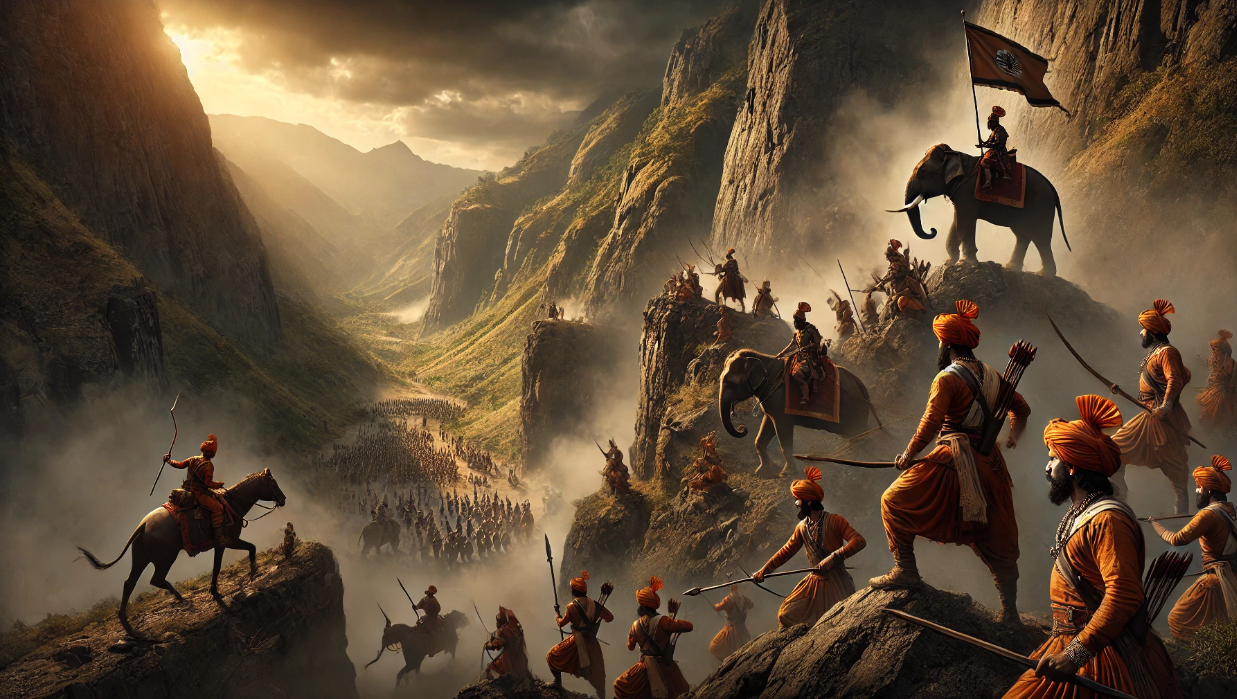
The struggle between the Marathas, led by Chhatrapati Shivaji Maharaj, and the Mughal Empire was one of the most significant conflicts in Indian history. It was a battle for self-rule (Swarajya) against the mighty Mughal dominance.
Reasons for Conflict
Expansion of the Mughal Empire: The Mughals sought to expand their rule over the Deccan region.
Shivaji Maharaj’s Swarajya Vision: His goal was to establish a self-governed Maratha state.
Mughal Oppression: High taxes and suppression of local rulers led to resistance.
Religious & Cultural Differences: Marathas opposed Mughal dominance over Hindu kingdoms.
Major Battles Between Swarajya and Mughals
Battle
Year
Result
Key Events
Battle of Chakan
1660
Mughal Victory
Marathas resisted for two months before fort fell to Mughals.
Battle of Purandar
1665
Mughal Victory
Shivaji Maharaj signed Treaty of Purandar with Aurangzeb.
Escape from Agra
1666
Maratha Success
Shivaji Maharaj escaped from Aurangzeb’s captivity in Agra.
Battle of Sinhagad
1670
Maratha Victory
Tanaji Malusare led a daring attack to recapture Sinhagad Fort.
Battle of Salher
1672
Maratha Victory
First open-field defeat of the Mughals by the Marathas.
Key Personalities
Shivaji Maharaj:
The founder of Swarajya and leader of the Marathas against the Mughals.
Aurangzeb:
The Mughal emperor who tried to crush the Maratha resistance.
Tanaji Malusare:
A brave Maratha warrior who recaptured Sinhagad Fort.
Jai Singh I:
A Mughal commander who negotiated the Treaty of Purandar.
Impact of the Conflict
Strengthened Swarajya: The Marathas proved their military strength and strategic capabilities.
Mughal Decline: Continuous battles weakened the Mughal Empire over time.
Expansion of Maratha Rule: Marathas continued their resistance and later established a vast empire.
Conclusion
The conflict between the Marathas and the Mughals was a defining moment in Indian history. Shivaji Maharaj’s vision of Swarajya laid the foundation for a self-reliant and powerful Maratha state, which later played a key role in shaping India’s history.